
From Certainty to Surrender
Learning to Trust God Without Having All the Answers

This post was a homily I prepared for Iona Anglican Church. I was invited to speak during the Second Sunday of lent March 1, 2026. In many ways, I wrote this piece to myself, understanding that Lent is a time of listening and discerning.
In the late 1970s, Fr. John Kavanaugh visited Mother Teresa at Nirmal Hriday in Calcutta, India. Known as the House of the Dying, it was a palliative care center for the destitute and critically ill, offering dignity, comfort, and presence to those nearing the end of life. Fr. Kavanaugh found himself at a crossroads. He was torn between remaining abroad to work among the poor and returning to the United States to pursue a university career. When he brought this uncertainty to Mother Teresa, the conversation went something like this:
“Is there anything I can do for you?” asked Mother Teresa. “Yes,” said Fr. Kavanaugh, “please pray for me. Pray that I might have clarity.” Mother Teresa then replied, “No. I will not pray for this. Your search for clarity is what holds you back.” “But Mother,” said Fr. Kavanaugh, “you have always had clarity about everything.” Mother Teresa looked back at him and said, “No, I have never had clarity. What I have always had is trust. I will pray that you will come to trust in God.”
So what happened afterwards? Well, nothing dramatic. Kavanaugh completed his period of service and went back to his Jesuit ministry in the States. He became a professor of philosophy and later served as president of Seattle University.
How many of us have found ourselves in the same situation as Fr. Kavanaugh? Praying for clarity about something, or praying for peace about a decision when trying to discern God’s guidance?
We frequently find ourselves in certain seasons asking God what is next, or around the corner. We face difficult decisions that require a quick response, or maybe you don’t know about the decision you need to make. Furthermore, there can be varying degrees of how clear or certain something needs to be in order for us to move forward on a decision. When I think back on a lot of things in my life, I don’t think I had 100% clarity on anything. Ever. It was never clear when I moved states. Twice. When I took a job. When the right time to start a family was. Or when I was pressured into buying the extended warranty for a product I knew I would never use.
Clarity does not come to us with a five-year plan or a detailed map that shows us where to go each step of the way. We like to imagine that as we mature in life, the knowledge of certainty will develop. Sadly, I have found that as I have grown older, several decisions I have made as an adult sound responsible yet internally are ones where ChatGPT or Google agrees with me.
Does the pursuit of certainty with God become something that holds us back in the pursuit of good things?
No one wants to make the wrong decision on something, especially when it comes to what God has entrusted to us. Yet, this is where the tension emerges. The same desire for certainty that begins as wisdom can quietly become a stumbling block to trusting God. A mask that hides how we really feel. Sometimes maybe a way of saying no. It’s not to say that I can’t have certainty on things; my relationship with certainty just needs to change.
I find that the beginning of Abraham’s journey holds deep significance for our spiritual lives because that’s how his story begins. It makes us scratch our heads at times because we wonder, what gave him the certainty to pick up his life and go to where God was calling him? This is something that has captured the imagination of ancient and modern readers alike. Yet the biblical authors seem to restrain themselves. They weren’t, after all, writing to us as 21st-century Americans. They assume that you understand the full context of what’s unfolding.
Abraham was a random pagan who worshipped many gods. His wife was childless, and that meant that his marriage was a failure. This would be incredibly shameful. Without an heir, your family line was considered as good as dead, erased from existence. His father had died, and he had become the new patriarch, now bearing responsibility for the family’s destiny. And so, Genesis 12 opens with Abraham’s response to an unknown, nameless God, promising him something beyond his understanding. He most certainly might have been thought of as crazy, or chasing the wind, yet the text spares us these details.
For Abraham, obedience came before certainty.
12 Now the Lord said to Abram, “Go from your country and your kindred and your father’s house to the land that I will show you. 2 And I will make of you a great nation, and I will bless you and make your name great, so that you will be a blessing. 3 I will bless those who bless you, and him who dishonors you I will curse, and in you all the families of the earth shall be blessed.”4 So Abram went, as the Lord had told him, and Lot went with him. Abram was seventy-five years old when he departed from Haran. 5 And Abram took Sarai, his wife, and Lot, his brother’s son, and all their possessions that they had gathered, and the people that they had acquired in Haran, and they set out to go to the land of Canaan. When they came to the land of Canaan,
Genesis 12:1–5a (ESV)
What was certain in his story? Abraham’s country, relatives, father’s house, the gods he worshipped even. Yet in spite of all of this, God tells Abram to go, and he goes. He doesn’t give Abram a timeline of events, nor a budget for travel, nor clouds in the sky pointing like arrows to Canaan. Abram makes the journey. He leaves all he knows and everything that has given him identity and meaning and sets off toward a dream that seems impossible.
You might be thinking, well, that makes sense. He reached a dead end, so it was time for new opportunities or a change. Others might wonder whether Abram’s faith was without reason, whether it was blind or perhaps a bit hasty. What it does show is that the journey with God begins to expand Abram’s imagination toward what once seemed impossible. Yahweh captures his attention in a way the other gods never had, awakening divine trust rather than a mere calculation.
Abraham is called to the journey of formation. The making of his great name was not just one that carried a royal tone, but one of character and exemplary stature.1 If anything, Abraham is a great example of what one’s life looks like with God. However, obedience to God is not a quid pro quo as much as we are tempted to think.
An obedient walk with God is the adventure of becoming who God calls us to be. When we feel stuck, when we feel like we don’t know what to do, when we’re at the end of our rope, or when we’re living the same day over and over again. So do we learn to say yes to God in the dark? The scope of Abraham’s obedience wasn’t just so he could get something back in return. He believed from the very first command that was given to him without having received anything at all. Perhaps that tells us something about the times we feel like God has nothing for us, you’re left waiting, or you find yourself in an unsettled place.
We don’t start obeying God to get what we want out of life. We start obeying because through him, we become who he forms us to be, and God shapes that life through worship.
Worship sanctifies our bodies for a holy life.
5 And Abram took Sarai, his wife, and Lot, his brother’s son, and all their possessions that they had gathered, and the people that they had acquired in Haran, and they set out to go to the land of Canaan. When they came to the land of Canaan, 6 Abram passed through the land to the place at Shechem, to the oak of Moreh. At that time, the Canaanites were in the land. 7 Then the Lord appeared to Abram and said, “To your offspring I will give this land.” So he built there an altar to the Lord, who had appeared to him. 8 From there, he moved to the hill country on the east of Bethel and pitched his tent, with Bethel on the west and Ai on the east. And there he built an altar to the Lord and called upon the name of the Lord. 9 And Abram journeyed on, still going toward the Negev.
Genesis 12:5b–9 (ESV)
Abraham’s journey descends from Haran to Canaan; to the large desert region in the southern part of Israel known as the Negev. I had always thought that this was just a field journal. A history of his travels showing the great distances Abraham covered, but the path itself is deliberate. Through Shechem, to the hill country east of Bethel, and then downward, toward Egypt. This is not a random adventure. It carries Abraham farther along the road he chose when he first said yes to God.
The land is said to be his future, yet every step through it raises the same question. How will this ever become his inheritance while Sarah remains barren? The journey itself holds that tension.
Yet along the way, God reveals himself, and at key moments, Abraham builds an altar in worship to Yahweh as he surrenders to him in dependence, gratitude, and hope.
Ambrose of Milan described Abraham as an athlete of God. A person whose faith was trained and strengthened through adversity.2 By going into the desert, Abram’s long trek was towards a place where trust in God was not theoretical but tested, revealed, and formed.
I don’t think we often realize that worship is not just curating our hearts to know God, but also training, equipping, and strengthening us in seasons where we question what God is doing—especially when we don’t know what is ahead.
Perhaps in this season, cultivating a heart of worship in dark or unknown seasons becomes crucial. As worship does not just inspire or awaken us to God’s presence, it also prepares us.
We don’t often think about this facet of what our worship is doing. The times where testing does come, and we are faced with tragedy, the death of a dream, a financial crisis, or the loss of someone we love, it is worship that prepares us in how we will swim through those waters faithfully with God.
Do we see our need to worship God when we don’t feel like it? When it seems like the goal is out of reach or when things seem to just be getting darker and darker? It is crucial we continue to worship because it trains us for these seasons so we may have the memory to depend on God when everything is stripped away.
Earlier in my ministry career, I was privileged to sit underneath a senior pastor who had been an expert at the pastoral craft for over three decades. The way he handled baptism, marriage, funerals, the way he prayed with people in crisis, his Sunday sermons. He even took the younger pastors like me out to lunch to discuss how theology and ministry came together.
I remember one time, my wife and I asked him what the hardest thing about leadership was, and his response was simple. It was wrestling with the question “Did I really hear from God?” It wasn’t that I didn’t think leaders like him could struggle with this sort of thing. He had uncertainty about people, situations, sermons too. What I was surprised was how he had learned to be okay with the uncertainty. Yielding to God’s presence when he didn’t have all the answers and continued faithfully on the journey in worship and obedience. This is how we learn to trust God in the journey of faith.
It isn’t a shrugging of our shoulders and passively submitting or stubbornly waiting for mystical signs to appear. It is a process of learning to listen and worship when we too feel unsettled.
Abraham makes a journey, and so do we during Lent, to the cross with Christ.
On this journey, we undertake the difficult work of recalibrating our hearts to the faith we are called to live, learning to listen when our need for certainty begins to overshadow our call to obedience and worship.
So is it wrong to pray for clarity? I don’t think it’s wrong to pray for guidance, for courage to take the next step, for grace in spaces where we feel uncertain, and for our decision-making to be sound.
If anything, the clarity you should be praying for in this season of Lent is that you see God’s love for you. The biggest moments of discernment in my life are the ones where I want to be in God’s love, and to know Him all the more.
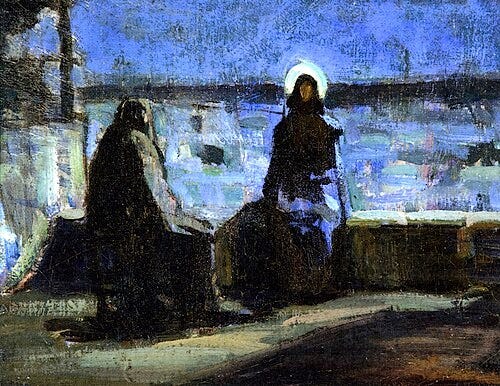
I like this photo I’ve included up at the top of Nicodemus and Jesus in John 3. We might feel like Nicodemus coming to Christ at night, in the dark, wanting to see Him, but not seeing Him fully. Reasoning, arguing, trying to put the pieces together about what we do know and where it all leads. Like the curious Pharisee, we too say, “How can these things be?” Yet, despite not seeing the end of the story, we are called to trust in the words of Christ.
Seeking clarity about who God is, and what He has come to do for us.
Bruce K. Waltke, Genesis: A Commentary Grand Rapids MI Zondervan 2001, 205.
Mark Sheridan, ed., Genesis 12–50, Ancient Christian Commentary on Scripture: Old Testament II (Downers Grove, IL: InterVarsity Press, 2002), 6.